30 October 2024

Honda ZR-V review: Brian Byrne, Irish Car


With the arrival of their new ZR-V on the Irish market Honda are filling an SUV gap between the HR-V in various iterations and the large CR-V, writes Brian Byrne. In addition, the very recent launch of the latest HR-V, along with the introduction of the latest CR-V earlier in the year, means the brand's whole lineup is arguably the freshest of any now available to the Irish motorist.

In its highly competitive compact segment arena, stylistically the exterior of the ZR-V has a softer look than most in the segment. That isn't a negative, just suggests the design is there for the long haul and won't date quickly. Close up, the detailing is very tidy and works well to create a relaxed but self-confident and quality impression.


Inside, that quality feeling is also very well executed in what many would regard as a very traditional manner. And y'know what?, that's really nice. Circular driver information dials with appropriate digital speed readout if desired. A central touchscreen that is small by the sometimes gargantuan offerings in other brands and models — it is nice to read that this is deliberate by Honda, who say they want to minimise the distraction issue of screens and retain the use of proper switchgear for climate and other systems management. Those on-screen functions they do allow are simply and clearly placed. 

If there's one matter where they might improve things, it's the selector for the automatic transmission, which is four buttons on the centre console, each a different size and action which I found confusing. A Stellantis-style switching, or a traditional stick selector would be much more preferable.


Seats are comfortable front and rear, the boot capacity at 380L is about average, you can get some 942L more with the back seats folded. There's a sense of a really good build quality, which is reassuringly Honda, both sitting in the car and while on the road.

The other big Honda thing has always been their powertrain engineering, and they have now fully adopted hybrid powertrains across their range. In the ZR-V's case, it is a 2.0 petrol engine and electric motor with a total 184hp output, a power-split system that seamlessly switches or merges ICE and EV to most efficiently power in the relevant driving load and conditions. The CVT automatic keeps everything very smooth. There's a 0-100km/h potential of under 8 seconds, which is slower than many of the pure battery electrics I've been driving in the last couple of years ... but it feels just right for the normal driving that virtually all owners in this class will do (speed-happy petrolheads are really just a tiny, tiny fraction of the motorist population).

All the foregoing said, the ride and handling are a good mix of comfort with agility where and when required — I do have a twisty local road where some of my review cars perform better on the push than do others. I'm of the view that comfort is more appreciated than tight handling, but the ZR-V won't let anyone down in the latter context.

All the usual driver assist tech is onboard. The ubiquitous audio warnings are blessedly non-peremptory.

There is a view that Honda in Ireland tilts into the premium space, and the pricing does reflect that when compared to the prestige equivalents. Is the ZR-V worth the money that needs to be put down? Well, that will depend on the buyer's own attitudes to premium badges as against soul appreciation.

PRICE: From €54,995. WHAT I LIKED: The car is true to the maker's key heritages. 


Another Chinese EV enters Irish market


Yet another Chinese brand is set to roll out in Ireland with the appointment of Motor Distributors Ireland as distributors for Xpeng, writes Brian Byrne.

The first model here will be the Xpeng G6 mid-size SUV, to be followed by other models from the brand.

All Xpeng models, including the G9 flagship SUV, and the P7 sedan with its Pt+ fastback variant, are full battery electric models.

The brand joins MDL's other Chinese makers distributed by the company here, the Smart and the BYD companies. 

25 October 2024

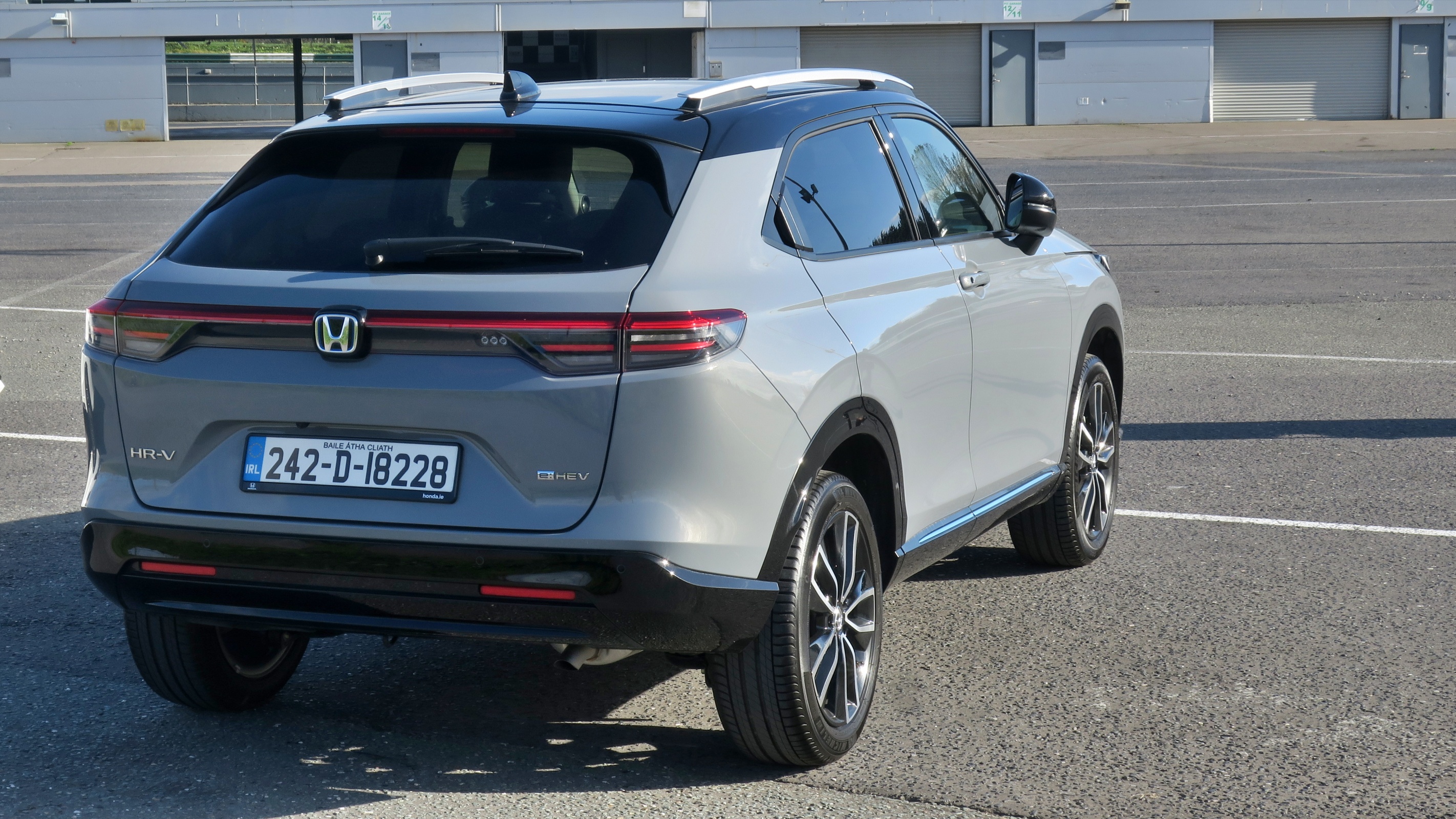
New Honda HR-V completes updated SUV lineout


A new generation of Honda's HR-V SUV is now on sale in Ireland at a starting price of €41,750, writes Brian Byrne. Styled to look more substantial than its predecessor two iterations, the latest version is longer and wider but retains the same wheelbase.

The new HR-V's powertrain is a petrol hybrid with a total output of 131hp and a rated fuel economy of 5.4L/100km. The engine package comprises a 1.5 Atkinson-cycle unit with two electric motors.

The car comes with a full suite of driver assist features, but with an interior design emphasis on traditional climate and audio volume switchgear and a relatively small touchscreen to minimise distraction.

There are four grade options, to a top price of €49,750.


Cars from Japan now top used imports sales


The number of secondhand cars imported from Japan has increased more than ten-fold since 2018, due in part to Brexit, writes Brian Byrne. To date in 2024, 22,482 such vehicles have been imported to Ireland, compared to just 2,621 six years ago, many of them including high-end European models previously owned by Japanese people.

According to key importer Automatic Motor Car Centre, based in Lusk Co Dublin, Brexit is just part of a 'perfect storm' in the used imports industry, along with ever-increasing prices for new cars, and Irish car buyers' demands for more value for money.

The change means that Japan is now the top source country for second-hand imports here, bumping the UK off top rung of the ladder it held until 2019. Cóilín Garvey, Sales Manager of AMCC.ie says motorists here have realised that Japanese imports are very well specced cars, much better than the average equivalent in Ireland. "In general, Japanese motorists look after their cars better than Irish drivers do," Mr Garvey says. "What’s more, Japan has one of the most advanced road infrastructures in the world, which helps to improve the longevity of these cars."

Japanese imports also tend to be packed with the latest technologies and that helps to make the cars top performers in terms of safety and fuel efficiency.

While one in four of the AMCC imports are bought directly by private buyers, the majority are stocked by secondhand car dealerships across Ireland. The importer has an exclusive partnership with NextGear Capital, the largest provider of stock funding facilities for used vehicle dealers, to facilitate these customers. 

Pictured are Cóilín Garvey, (AMCC Sales Manager); Áine Cantwell (AMCC Business Manager); Anthony O’Neill (Account Manager, NextGear Capital); and Peter Molloy, (Ireland Manager, NextGear Capital) at the announcement of the partnership between the two companies at the amcc.ie premises in Lusk, Co Dublin. 

23 October 2024

Peugeot 2008 review: Brian Byrne, Irish Car


What does it say about Ireland's car buyers when there are only two B segment cars in the top ten, and that across Europe the same league features five models from that segment? writes Brian Byrne. Or that Ireland's top-selling model is a fairly pricey SUV and across Europe it's a budget hatchback? Does size matter more to Irish motorists? That five of the top ten sellers here are mid-size SUVs kind of answers that question.

Maybe it's a case of family-carrying cars being more essential in a country like hours where public transport has never caught up with the public's transport needs, even in the city areas. Maybe it's just that we like big.

So to the Peugeot 2008 which I'm looking at this week. A sub-compact crossover and the 16th biggest seller across Europe last month, in Ireland at number 33 in the sales league this year. I think it deserves better from us.

It's the second generation of a car originally designed to replace a wagon version of the 208 hatchback, and which had a facelift last year that tweaked up what was already a car with a strong presence in its segment. With a lot of style elements in the grille, lights and apron that could seem to be working against each other, the overall effect is actually an aesthetic positive, especially if you want your small crossover to reflect your own personality.

My review car's dark grey and highly styled alloys meshed well with the black roof rails and other aluminium trim, maintaining the edginess of the overall look. The rear hatch is designed to add perceived width to the car, giving it a bit  more apparent overall size than some B segment competitors.


The interior fittings follow the same strong styling as the exterior, a lot going on in the dashboard shape including a stripey finish and high gloss black trim edged in metallic detail. The infotainment screen is set on its own shelf and angled towards the driver. There are good piano-style switches below it, and a knob volume control, for key on the run adjustments without too much distraction. The driver information is in the familiar above-the-steering wheel space, easy to engage with, and the 'hard' switching on the steering wheel is welcome. In the E-2008 the transmission selector is the now very familiar flip-switch style that is my ergonomic favourite.


The review car was the top GT grade, which added some sporty touches to the trim. The car has supportive front seats, and good space for two in the back ones, three young teens would also be OK. It's the nature of such small SUVs to be closer to a compact family hatchback in both back seat accommodation and luggage capacity, and this one has a very commodious boot even under the rear shelf.

The powertrain in my car was, as suggested above, electric. With 156hp of power, the 0-100km/h capability is a tad over 9 seconds and therefore reasonable rather than irrationally fast. The refresh last year added a larger battery, and while driving the car I averaged some 13kWh/100km, which gave me a fairly accurate range in excess of 400km on a full charge. As with all electrics, a quiet and smooth drive.

I also had time in an updated petrol version of the 2008, with a manual gearbox. All I've said about the car applies except that my wide foot on the clutch tends to catch the footrest in any manual cars on this Stellantis platform. It's annoying, but not a problem if you own the cars and get used to them. Still, I'm very fond of my automatics. Also I should mention there's now a hybrid version of the car, which I suspect I'm going to like.

A strong looker, feeling well built, and rather more space than a small-car hatch. Maybe you don't really need that large SUV?

PRICE: From €32,995 (100hp petrol), electric from €32,905 after subsidies; review car €36,640. WHAT I LIKED: Peugeot still leads with their style. 


21 October 2024

Revised Nissan Qashqai arrives


Nissan Ireland has launched a revised version of the Qashqai with distinctive changes to styling and updated connectivity technologies, writes Brian Byrne. Prices start at €39,000.

In addition to the e-Power hybrid powertrains already familiar in the model, a new mild-hybrid 1.3 petrol engine is being introduced.

The interiors of the car have also been revised to provide what the company calls a more premium feel.

The Around View Monitor system now features a 3D function allowing the driver to see the car not only from above but also from eight different external camera view points


18 October 2024

MG announces Cyberster pricing


MG in Ireland are back in the sports car heritage of the marque with the pricing announcement for their all-electric Cyberster, writes Brian Byrne. Debuted in Europe at last year's Goodwood Festival of Speed, the 2-seater will be available with RWD and AWD powertrains.

Prices start at €69,000 for the single-motor car, and from €75,500 for the dual-motor AWD car. Power outputs range from 340ps to 503ps, with a claimed 3.2s sprint to 100km/h capability for the more powerful car.

A fully-electric fabric hood can be raised in 15 seconds while the car is moving at speeds of up to 48km/h.

MG Motor Ireland will be announcing selected Cyberster dealers in Ireland shortly. 


17 October 2024

My first adventure in new Ford Explorer EV: Trish Whelan


Ford’s choice of an adventurous back-to-nature theme for the UK and Ireland launch of its new Explorer proved an appropriate one for this new all-electric crossover SUV, the first in a wave of new electric vehicles for Europe that will signal a complete reinvention of the brand. 

The New Forest area of Hampshire, England’s smallest National Park, provided us with a calming yet adventurous experience driving over country roads in and around the famed 400 years old woodlands grazed by deer, cattle and the Forest's indigenous ponies. It is also favoured by hikers and families who explore the many trails throughout the forest. 


Explorer is a new mid-size, five-seater vehicle engineered and assembled in Ford’s state-of-the-art electric vehicle centre in Cologne combining European engineering with strong American styling. It is actually built on the same platform as the Volkswagen ID.4 so both models share some components. Explorer is equipped to set active families on the road to adventure with features that include the option of a sleeping tent that sits on top of the vehicle. (The Select version is pictured above).

In size, Explorer is just a bit smaller than the Ford Kuga but has a longer wheelbase at 2767mm. Ground clearance unloaded is 193mm, and when fully loaded is 141mm. 

All the Ford UK top brass were on hand for our introductory presentation including Lisa Brankin, Ford Chair and Managing Director Ford UK and Ireland as well as those involved in the design and engineering of the Explorer in Europe which all helped emphasise the importance of the launch. Jordan Demkiw, Exterior Design Manager, said when they set out to design the car they wanted a very bold and confident vehicle, 'something that will exemplify the spirit of adventure and exploration’. 


The design includes a strong clean and friendly front end. The car’s futuristic exterior styling is matched by the ultra-modern interior with premium materials and features like sculpted sporty seats with integrated head rests and a massage function for the driver as standard on every Explorer which wasn’t needed when driving in the calmness and tranquility of roads in The New Forest where ponies grazing along the roadside barely lifted their heads as we slowly passed by. 


As this is an electric car, the designers could free up the centre console from more traditional controls and reuse the space with the 14.6-inch supersized movable touchscreen that you can lift up, leave in any position you find comfortable, and can also store your valuables in the Secret Locker behind the screen, and then lock it at the lowest position. The Ford SYNC fully connected infotainment system wirelessly integrates Apple CarPlay and Android Auto and comes with a built-in EV trip planner and satellite navigation. The extendable MegaConsole storage space between front seats with its 17 litres of space provides enough room for a large handbag, or laptop. It held the two large cold bags that contained our lunches on the day, with plenty of room to spare. The 5.3-inch digital cluster has all the trip information you could require. Driving the top Premium grade, I was intrigued by the shape of the soundbar-style B&O speaker on top of the dash which looks like something from outer space has landed there. The top trim has a power tailgate and boot space of 450 litres. 


A suite of advanced driver assistance features include Adaptive Cruise control, adaptive matrix LED headlights, and a 360deg camera. The driver Assistance Technology Pack features 12 ultrasonic sensors, five cameras and three radar sensors to keep you safe on the road. The Rear Wheel Drive 77 kWh Extended Range cars were available for us to drive in both the Select and Premium grades. Both have 1-speed automatic transmission. Other common features include max power of 286p, torque of 545 Nm, a 0-100km/h acceleration of 6.4 secs, combined energy consumption of 14.7 KwH/100kms, rear view camera, front and rear parking sensors. 

Explorer can undertake longer journeys with more than 600km driving range possible from a single charge with both of the extended range RWD models which eliminates any problems with range anxiety. The range is a bit less at 570kms for the Premium grade. Both grades can be fast charged from 10pc-80pc in around 26-28 minutes using up to a maximum 135 kW DC fast charger. 


While I enjoyed all the comfort the entry grade had to offer, stepping into the Premium version with its added luxury such as the panoramic sunroof and enhanced features soon made it my clear favourite of the two. Finding a perfect driving position was easy with the 12-way power seat adjustments. The excellent head-up display also helped, not to mention all the top end driver assistance and safety features that really impressed. Despite on-road testing, I could find no obvious fault of any kind with the car and thoroughly enjoyed both test drives travelling in big comfort with plenty of power if needed and look forward to driving the Explorer back in Ireland for longer test drives. 


Explorer prices start at €43,591 for the Select model; the Premium comes in at €48,006. Both prices include €3,500 SEAI EV grant & VRT relief for eligible variants.


Phase 2 of charging infrastructure grants rolls out


A new phase of government grants aimed at increasing the number of public chargers for electric vehicles has just opened for application, writes Brian Byrne. The scheme, known as LDV 2, will target over 1,200km of national single carriageway roads and will support the roll-out of EV recharging infrastructure pools at a distance of no more than 60 km between them in each direction.

The scheme is open to petrol/service station operators, car park owners, hotels, supermarkets/retail outlets, and anyone with a publicly accessible site within 3km driving distance of the Scheme roads. The closing date for application is 15 January 2025.

This scheme is part of the wider ZEVI National Road Network EV Charging Plan, which earlier this year awarded grant funding to deliver 131 new high-powered recharging points for electric vehicles at 17 locations along the motorway/dual-carriageway network.

According to Transport Minister Eamonn Ryan, all the chargers under the overall scheme are expected to be in operation by the end of 2025. The scheme is costing €100 million. 

16 October 2024

Ford Explorer first drive: Brian Byrne, Irish Car


To all intents and purposes, Ford has just three models in the Irish market — Puma, Kuga and Focus, writes Brian Byrne. Three pillars, at 82pc of all Ford sales this year, which are the support for five models selling here. One of those pillars, Focus, will disappear next year, as did another equally important one, Fiesta, in 2023. Ford sales in Ireland in 2024 are 37pc down on the brand's performance in 2019, when Focus was their biggest seller and Fiesta their second. Can the carmaker afford to lose that other leg?

A recent first drive in Ford's latest offering, the Explorer, got me thinking about a brand that just ten years ago was constantly tangling tightly with Toyota and Volkswagen for top market share here. Now in a sad sixth place and dropping. Do they care? At a global level, maybe not. As long as the company's commercial vehicle range, Transit, keeps the European flag flying profitably. And the American home buyers keep driving big-margin F-150 pickups off the dealer lots.

After one of the most drawn-out pre-launch in this writer's recent memory, the Explorer EV has landed in Ireland. It is being marketed across Europe as 'iconic' — there has been an Explorer SUV in North America since 1991. And also as an adventurer's car, with the build-up to launch including around an the world trip by influencer Lexie Alford, who holds the record for the youngest person to visit every country of the world.

Explorer is an imposing vehicle, looking larger than the VW ID.4 to which it is related by technology agreements between the two brands, though it is actually shorter. A high flat front, substantial side view sheetmetal, and a strong rear treatment push the utility aspect with some good old Ford style, a skill in which the company has always excelled.


Inside, the stylists have also worked some Ford magic, in this car's case suggesting topical sustainability with a very clean and unadorned design. But retaining a sense of quality that the car should have, not least because of its price segment.

The vertical 14.6" centre screen is dominant, but set below the dashboard top line so it doesn't get in the way visually. I'll touch briefly on its operation in that it is one of the better such systems I've used, intuitive and not requiring much menu-jumping for key functions. The driver information panel through the squircle (yep, that's how Ford describes the shape) steering wheel shows just the right amount of information in good graphics, much of which in my first drive car was repeated in a bright head-up display. Using the inbuilt navigation as opposed to my usual Google Maps actually proved to be quite satisfying, with the advantage that directions also repeat in the head-up.

That thing that looks like a small surfboard on the dash is actually a sound beam. Volume for the driver is easily adjusted by steering wheel controls, but passengers can get frustrated with the VW-style finger-slide or tap control located at the base of the centre screen.


This on my first experience is a very comfortable and nice riding car, and very roomy even though it's actually smaller in all exterior dimensions than stablemate combustion-PHEV Kuga. I was impressed with the driving experience on my first time in the Explorer. I'll have more detail when I get a full review chance. But it has the look and feel of a very good car.

However, it's not a replacement for the Focus, and certainly not for the much-loved Fiesta which was the choice for generations of first-time drivers. Ford has suggested a new small EV for Europe in 2026, but there's no doubt the blue oval has struggled to hold onto the ball in its European strategy.

PRICE: From €42,119; WHAT I LIKED: Ford can still do style that satisfies. 


New BMW 2 Series Gran Coupe on sale here


The new generation of the BMW 2 Series Gran Coupe is now available to order in Ireland, with a starting price of €46,505 OTR, writes Brian Byrne. First deliveries to customers here are expected from March 2025.

Two versions will be available, a 170hp with 48-volt mild hybrid technology and an AWD with 300hp and the capability of achieving 0-100km/h in 4.9s.

A 7-speed dual-clutch automatic transmission is standard in the new car, as is adaptive suspension.

The interior of the all-new car features the latest iterations of the iDrive and BMW OS9 driving and parking assist technologies.  


MG3 Hybrid review: Brian Byrne, Irish Car


I remember the first time I saw a Chinese SUV at a European motor show, writes Brian Byrne. So forgettable that I can’t remember the year or the car brand. Or even at which of the three shows I regularly attended it was exhibited. But I do remember the unattractiveness of the materials and interior design, and the very iffy build quality compared to what we were even then used to from European carmakers. "Won't work here," I said to a colleague then. It didn't.

But China learns quickly. Anyone in the last few years who has gotten into the new cars from a variety of the Asian giant's carmakers will have been struck by the perceived quality, and the luxury intent of their higher-end cars. As well as in the originally European brands now owned by Chinese companies, such as Volvo. All have the tech, the style, and the quality.

None more so than MG Motor, the current iteration of the 1924-founded British sports car marque owned today by the Shanghai car giant SAIC Motor. This is China targeting not the luxury market, but the everyday mainstream. In 2013 some 513 Chinese MG cars were sold in Europe. Last year, a decade later, that figure hit 231,684 units. Much of that success has come from demand for the MG4 electric car, but now the MG3 Hybrid+ has arrived. "This will certainly work here," I said to that same colleague last week.

The B segment car is a tad larger than the now discontinued Ford Fiesta and the latest Suzuki Swift. It has an attractively lively design at the front, some good side sculpting, and a safe rear hatch style made distinctive by a large MG badge.


Where the model really scores is with the interior, featuring a tidily styled dashboard with separate infotainment and driver information screens, both well located and with intelligible graphics. The touchscreen seems to be a generation better than I remember in the MG4 EV I drove last year, and which was poor. China learns. Quickly. Underneath is a line of physical switches for some climate control and radio volume. Apple CarPlay had to be wire-connected, and created an issue that the switch to access the climate detail page then no longer worked, and I had to exit CarPlay to do anything with heat or cool. China will learn.

The hybrid powertrain means automatic, and transmission selection is via a big knob on the centre console. Visible and virtually impossible to do anything incorrectly, I like it. The hexagonal steering wheel feels good, though the remote toggles for navigating functions are not as clear as some. China will learn.


It's what we used to call the supermini segment, so in reality a 4-seater hatchback with room for an occasional fifth as long as all in the back are children. But every seat is comfortable. And everything looks good and feels solid. China has learned.

The hybrid powertrain is new to the brand, and in my experience with the car it works well. A larger than usual electric drive battery for the segment means a significant amount of town driving is done electrically. There's a 3-speed automatic rather than a CVT auto transmission, and when the 1.5 inline four cuts in, it does seem to be revving high, possibly because the Atkinson cycle it's set up for is more efficient for hybrids. No rev-counter, so I couldn't see visually what was happening. But the overall drive in whatever mode the system chose was good. An 8-second sprint to 100km/h is claimed, and without measuring that there was certainly a decent sense of push when accelerating to pass. I averaged 4.5L/100km through my time, and that's a decent economy.

All driver assist is part of the package, and the annoying alerts that we're all starting not to hear. Won't go there.

This car is going to do very well, everywhere. Especially priced as it is before that extra EU duty on Chinese-made cars arrives.

PRICE: From €23,995. WHAT I LIKED: China has learned.  


15 October 2024

Audi's A3 Sportback has more power and efficiency


A revised Audi A3 Sportback TFSIe is now available to order in Ireland at a starting price of €51,410, writes Brian Byrne. Two versions available include a plug-in hybrid with a rated EV range of up to 141km.

A new turbocharged petrol engine underpinning both variants improves both efficiency and engine longevity. A dual-clutch automatic transmission is standard.

Changes to the charging system now allow it to recharge at high-power stations, with up to 80pc of fresh charge available in less than half an hour. 

11 October 2024

Mazda CX-80 on sale in Ireland


Mazda's new flagship car in Europe is now available in Ireland at a starting price of €61,380, writes Brian Byrne. The CX-80 is a three-row SUV which can be configured for six or seven seats.

Available in five grades, the car is powered by a 2.5 plug-in hybrid petrol engine outputting 327hp, or a 3.3 diesel with 254hp.

All versions are all-wheel-drive, with 8-speed automatic transmissions.

There's a claimed EV driving range of 60km. 


Dublin councils initiative for more public EV charge points


A cooperative initiative by Dublin's four local authorities will see over 200 public fast-charge units installed over the next two years to facilitate EV owners who can't charge at home, writes Brian Byrne. The selected provider is Irish company ePower.

The first 200 chargers will be placed at 50 locations, including local authority-owned car parks in Dublin City, Fingal, South Dublin and Dun Laoghaire-Rathdown. Other locations will include community centres, libraries and sports clubs. Overall, the Dublin EV Strategy developed by the four councils envisages 1,650 charge points being deployed at highly frequented destinations.

Initial facilities will be at Bremore Castle, Howth Harbour, Bushy Park, Tallaght Stadium and St Anne's Park, as well as a number of libraries and leisure centres.

The authorities believe that around 138,000 EVs will have been registered in the Dublin area over the next few years. Around a quarter of those EVs will rely on public charging because their owners live in apartments townhouses and terraces, limiting access for home charging.

Pictured at the launch of the initiative are Alan Hayes, Deputy Mayor, South Dublin County Council; Teresa Walsh, Director of Services, South Dublin County Council; and Damien Mc Nulty , Senior Engineer, South Dublin County Council. 

10 October 2024

VW debuts new large SUV


Volkswagen has revealed full details of a new large SUV, the Tayron, writes Brian Byrne. It is due to arrive in Ireland early next year.

The Tayron slots between the Touareg and the smaller Tiguan, and will be available with five or seven seats. 

A total of seven powertrains are available across markets, for Ireland there will be plug-in hybrid and diesel options at the start. All cars will be automatic.

Irish pricing will be notified closer to launch, but in initial european continental markets Tayron prices start at €45,475. 


9 October 2024

Mini Cooper Convertible making open air comeback


After an absence of nine years, the Mini Cooper Convertible will be rolling into showrooms again at a starting price of €36,730, writes Brian Byrne. First deliveries are expected in early 2025.

The latest variant will complete the renewal of the Mini models range which has been happening over the last 12 months.

Two petrol engines will be offered, a 163hp version and a more powerful S model with 204hp.

Operation of the soft top is fully automatic and can be closed in just 15 seconds. There's an integrated automatic rollover protection system. 


Fiat 600e review: Brian Byrne, Irish Car


It's a long time since I looked under the bonnet of a new car, writes Brian Byrne. I only do that now when sent to check the fluids on our small family hybrid. An opportunity to marvel at the mix of engineering, plumbing and electrical work that the internal combustion engine has become since first developed in the late 1800s. There's mystery and symmetry in the packaging which still deserves observation.

I used to be able to poke around in that space. Resetting noisy tappets, cleaning burnt distributor contact breakers, oil changes needed much more frequently than now. Mostly that stuff became irrelevant, unnecessary, or impossible to the ordinary non-mechanic. But it was always interesting to look at how improvement and innovation was changing the look of an automotive system that fundamentally hadn't changed, yet had changed utterly. 

With the arrival of EVs, there's now no reason at all to open the bonnet. There's likely to be nothing more than a small storage 'frunk' to be seen. Traction batteries and sealed electric motors don't have the same 'wow' factor as had the proud engineering around pistons in cylinders, valves, crankshafts and transmissions, carburettors and even fuel injection arrays. A whole visual of mechanical mystery is leaving the automotive room. Once something that elicited similar passions as in those who follow football teams, the car is well on the way to becoming the equivalent of a fridge on wheels. Unseen underpinnings all the same, with different badges and shapes.

Which brings me to the latest EV from Fiat, a brand that in Ireland has been in the doldrums for a decade but is now in revival through the Stellantis group's distributors here. But being part of a global something put together by merging a number of smaller groups with multiple marques already, it all becomes rather a badge engineering exercise. So the 600e shares its platform and running gear with Opel's Mokka and Corsa, Peugeot's 2008 and 208, Alfa Romeo's Junior, the DS 3 Crossback, and the Jeep Avenger. 

The 600e's style doesn't try to stand out much apart from the quirky 'face' with flirty eyelids over the lights and the overall look a perpetual smile. The profile is devoid of tricky design details, albeit an interesting sill-level 600 logo-and-chrome line and wheels which look like they came directly from a motor show concept. The rear treatment is neat, unfussy to the point of making little lasting impression. In short, it's a car for everybody who doesn't care about showing off their automotive style. Which is possibly a growing cohort of buyers.


The inside has direct reflections of the Jeep Avenger. The transmission selector row of PRND buttons at the front of the centre console, the lid of which folds open like an Apple iPad cover. Above these a line of real switches for climate control, and a radio volume knob that has disappeared from so many cars. The infotainment screen is mounted high, with easily understandable graphics that even make the touchscreen less difficult to manage on the move. The little but perfectly adequate driving information pod is uncluttered and immediately comprehensible.


The review car came in a light ivory upholstery with unusual decorative texturing. Plenty of room for me in the front, not so much in the back for anyone behind me. But this is a sub-compact, so for most purposes a reasonable four-seater for the not yet grown family.

It drives like, well, yes, any of its Stellantis electric cousins. Which is smoothly and quietly and not trying to masquerade as anything but a car to do what most owners want, get from place to place reliably and in some level of comfort. 

This was the electric version. The range in my car turned out to be what I believe was a fairly realistic 400km. The platform is also designed for hybrid powertrains, and there's one in the list. When I drive that one, I probably will take the opportunity to look under the bonnet.

PRICE: Hybrid from €28,995; review EV €32,995. WHAT I LIKED: No fashion pretending. 


New Polestar models launched


Polestar have launched two new models, the Polestar 3 and Polestar 4, writes Brian Byrne. There is also a new version of their Polestar 2. All are fully electric.

The Polestar 3 has a starting price of €93,200 and a rated range of up to 631km. With 489hp available, the claimed sprint performance to 100km/h in 5s. A version with a Performance pack improves this to 4.7s, trimming the rated range to 561km.


The Polestar 4 starting price is €68,600, with 272hp and a rated range of 620km. A dual motor version starts at €76,200.

The new version of the Polestar 2 which was first launched in 2019 has now been changed from front wheel drive to RWD. The rated range is now 554km which is greater than before. With 274hp available it is also significantly more powerful — a 0-100km/h in 6s is claimed. The price is from €53,195. 

8 October 2024

Pedestrians are a fifth of road deaths


The number of pedestrians killed in road incidents totalled 164 between 2019 qne 2023, writes Brian Byrne. In addition, 1,426 pedestrians sustained serious injuries over the same period.

A report highlighted by the Road Safety Association notes that the deaths accounted for 22pc of all road fatalities over the period.

Almost a quarter of those killed were aged 75 or over, and more than one in five of serious injuries were suffered by children aged 15 or younger.  

Kia prices the EV3


Kia's latest electric car, the EV3, will arrive in Irish dealers in November at a starting price of €36,790, writes Brian Byrne. The car will fill out the brand's electric range of Niro EV, EV6 and EV9.

The car will be available with two battery sizes, offering rated ranges of up to  436km and 606km. A breakthrough charging speed is claimed compared to rival models.

There will be three grades, with the top of the range GT Line costing €47,190.

A 0pc finance will be available for the 251 registration period.