Showing posts with label Glasgow. Show all posts

17 March 2014

Ingliston Country Club is a break from the city


Just as a finisher for this short stay in Glasgow, let me suggest a place for Sunday lunch that's one of those great places for families, writes Brian Byrne.

The Ingliston Country Club & Equestrian Centre is less than half an hour's drive from the city centre, and offers really good food in an unusual ambience.

The Palomino's Restaurant in the complex has a carvery, set and full menu offering of Scottish and Italian cuisine, is very reasonably priced, and there are shops, stables and other attractions to browse around afterwards.


The unique Palomino's restaurant views directly onto two full indoor horse arenas, and diners can watch ponies and their riders practicing and being coached as they eat. There are facilities to stable up to 200 horses on the complex, and accommodation on the hotel side of things includes a range of rooms and chalets very handily placed for motoring tourists to investigate the coasts and countryside around this part of Scotland as well as the city of Glasgow itself.

Time for the home drive ...

VisitScotland
For more information on holidaying in Scotland in the Year of Homecoming go to www.visitscotland.com

P&O Ferries
We travelled with P&O Ferries which operates from Larne to Cairnryan and Troon, the shortest, fastest crossings to Scotland. Online fares start from just £74 single, car plus driver. For further information on all sailings and the latest P&O offers, please visit: www.POferries.com

Glasgow Comedy Festival
www.glasgowcomedyfestival.com

Glasgow City
http://peoplemakeglasgow.com/

VisitScotland’s internationally recognized Quality Assurance scheme is a benchmark for quality and service standards across the tourism industry and operates across accommodation, visitor attractions and food sectors.

16 March 2014

Glasgow shopping as a Sunday morning marathon


If you're of the 'shop till you drop' persuasion, then Glasgow can certainly accommodate your fix, writes Brian Byrne. But be warned, it can be a marathon.

Finding the best areas is easy, they're all contained in a mostly pedestrianised section in the 'L' of Sauchiehall St and Buchanan St, with the corner being the Glasgow Royal Concert Hall (above) which anchors the Buchanan Gallery indoor shopping centre. The statue is of Scotland's first First Minister, whose Dewar surname suggests whisky connections.


Shopping is one of the Glasgow religions, so the Gallery — as are most of the shops on Buchanan — is open from 10am on Sundays. Planning can be done from one of the mall's coffee shops before the bags campaign proper begins. The Gallery opened in 1999, and has more than 90 shops with all High Street names and more, some of them unique to the mall.


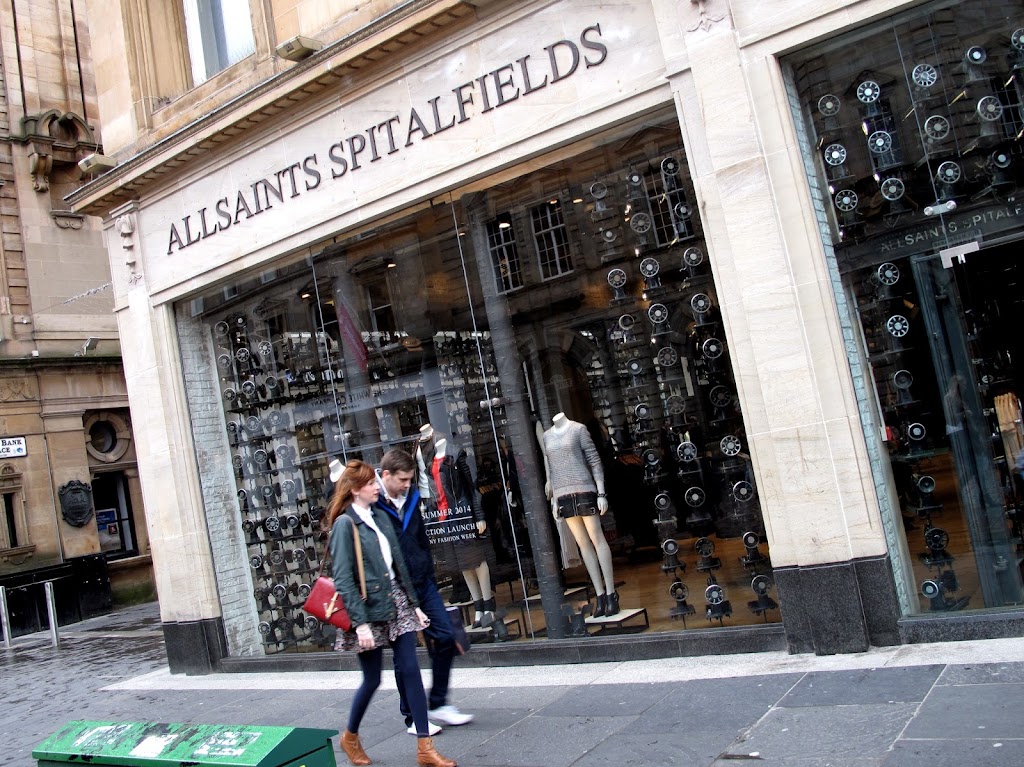
When you've managed that, the long vista of Glasgow's 'Fashion Mile' Buchanan St beckons, obviously with very many bespoke and big name clothing stores. An intriguing one is the Allsaints Spitalfields (below) which doesn't put clothes in its windows, but has no less than 1,100 vintage Singer sewing machines as its key decorative feature. The link? Hey, obvious, clothes have to be sewn. And now we know where all those machines that used to be on all those treadles that have become bar and restaurant tables have gone to.


If you need a break as you head down towards St Enoch's Square and its own shopping centre at the bottom, Sloan's Market is open both Saturday and Sunday, just near the Argyll Arcade off Buchanan. In truth there's not a lot there, except Sloans 'oldest bar and restaurant in Glasgow' in the lane. But if you're looking for a bit of jewellery, Sloans opens into the Argyll Arcade (above), an L-shaped mall of all the big names in diamonds, pearls and watches. The security men at each entrance to the arcade wear top hats and tailed coats ... but their high-tech earpieces signal them as being right in the 21st century.


Walk back up and you can dip in and out of the Prince's Arcade (above), a quite beautiful four storeys of shops and wood-trimmed escalators which mixes an upper level of quality with very modern retail therapy.


Pubs are scarce on Buchanan itself, but near the Merchants City area there's the Counting House, which this morning seemed to have an early dispensation and its large ornate central bar was ringed four-deep in red-and-white garbed football drinkers. The visiting supporters' slogan was 'The Sheep are on Fire', so if you're into football, you'll probably know. Later: Aberdeen FC. Thank you, Mr Google. Would have loved to stay, but getting a pint looked like too much work.

So this is being written in the relative quiet of the Admiral pub across from my hotel. Later this afternoon, off to the Equestrian Centre.

No louts on Glasgow's Subway


"Transport Police to Buchanan Station, please."

The message broadcast at the city centre station on Glasgow's diminutive underground train system was unequivocal, writes Brian Byrne. Loutishness will not be tolerated.

As I exited the station I had no doubt that the group of lads shouting and stamping in the train on the opposite platform would quickly be told where to get off, and helped firmly on their way.

The Subway is the third oldest in the world, established in 1896 and originally operated by a clever and clean cable system powered by a central steam engine. Nowadays it's electric, bright, efficient ... and cute.

It's a small gauge track, and the modern trains are painted orange, though that's not the official name of the colour because of political concerns. The system is also circular, so it's possibly the easiest to navigate in the world too. It was completely modernised in 1980, and the system continues to be updated. Easy, rechargeable 'smart' tickets are used.

With 15 stations and something over 10km of track, it's a real handy way of getting around Glasgow's centre and the Clydeside area.

I got on board at the Partick Interchange station, a bright and modern facility in one of the historically ancient neighbourhoods of the City. The really cool sports-based murals on the gables of the buildings in the square give it a vibrant feel. Sport has a history here too — Partick was where the first ever international football match was played, in 1872 between Scotland and England.


And, by the way, thanks to the Subway I got back to base nicely in time to see Ireland win the Six Nations. It was a hard game against France, which is the best way to win.

Finally, don't ask locals how to get to 'The Clockwork Orange'. The story that this is the nickname for the system is a media invention from the time of modernisation. It's 'The Subway'. Used to be 'The Snoogly Train', but that's another story ...

Now I'm heading out to see what a Sunday morning has to offer in this fascinating and vibrant city.

15 March 2014

Where transport history is Glasgow


For anyone with even a passing interest in the history of transportation, the Riverside Museum in Glasgow is a must-visit pilgrimage, writes Brian Byrne.


With an extraordinarily eclectic mix of some 3,000 exhibits, this winner of the European Museum of the Year 2013 offers insights into the development of many modes of transport, and the motive technologies — many of them developed on Clydeside — that underpinned them. As well as a lot more.

It's a particular treasure trove for those interested in trains, ships and cars. And the way they're all exhibited mixed together is wonderfully quirky and attractive. For the time I spent mooching this morning, there was a constant silly smile on my face as I kept coming across nuggets which triggered personal memory, stimulated my (imperfect) knowledge of transportation history, and introduced me to things I never knew in terms of mechanical invention.

The Riverside Museum is the fourth home of what was originally the City Industrial Museum which showcased the engineering and invention of Glasgow in the latter part of the 19th century. In a purpose-designed and architecturally innovative building where the River Kelvin flows into the Clyde, the Riverside Museum is a keystone element in Glasgow's regeneration of the banks of the waterway from where the city built its wealth and reputation through centuries.


One part of that is actually outside the museum, the Glenree tall ship berthed at the back which symbolises the major trading across the world's oceans for which Glasgow business people were the entrepreneurial hubs.


Back inside are details and models of other ships from that age of sail, and how they were relegated by the local success in developing steam ships like Henry Bell's 'Comet' of 1812. There are later connections with the Queen Mary and other great 'Queens' — like the carpenter's tools used in the construction of one of them (above).


There are trams — Glasgow had one of the most technologically advanced tramway systems until they were retired in 1962 after serving the city's public for 90 years. There are trains built in Scotland and operated from there, and in some cases retrieved for the museum from other parts of the world to where they had been sold.


For an automotive buff like me, there are cars from my childhood memory and growing up which drowned me in nostalgia about by father's, and later my own cars which did similar duties in transporting our respective families through their rearing.


There are even prams, that mode of baby transport which has been left behind by the complicated baby buggies which are now de rigeur, not least because they can be folded into the backs of cars. My own first few children had prams. None of my grandchildren have had.


There's a Merryweather fire engine which was used for decades by Galway Urban Council from 1928 after its first Fire Station was set up following a series of disastrous fires.


And what's nice about so many of the exhibits here is that there are personal stories about the people connected with them. One that particularly stands out is the 1954 wooden rowing boat designed by Ben Parsonage of the Glasgow Humane Society for rescuing people in the Clyde, or, sadly, for safe retrieval of their bodies.

There's so much there. But this account can only be a taster of what is so far, for me, the best from what I've encountered this weekend in Glasgow.

You really need to come up here and see it for yourself.

Now, I have other things to suss out here. But there's the little matter of a rugby match at 5pm ...

A bit of pedal power at the Velodrome


"You need to do a little dance with your foot to release it."

Doug, the coach at the Sir Chris Hoy Velodrome in Glasgow's East Side was explaining the mysteries of cleats to those of us who cycle normally with pedals only, writes Brian Byrne. He also showed us how basic the bikes used were — no brakes, a fixed hub so that slowing down is a matter of slowing the speed your legs are pedalling. And very light.

Nope, I didn't go all the way up to the steepest part on the ends, but over an hour or so a number of us novices did get the hang of the idea anyway. It's a really great facility, part of the Emirates Arena Complex built for the Commonwealth Games this summer. At a cost of £113m, the whole complex is a wonderful facility for the city and its residents. It includes a full gym and a spa, as well as an indoor arena with running tracks and netball courts.

The Velodrome is one of only five in the UK, and is named after Scotland's most successful cyclist and Britain's best medal-winning Olympics athlete. It will seat 4,000 during the Commonwealth Games, and the arena can hold 6,500 people.

Many, many more than were there to see me eventually run out of puff this morning and leave the track ... but you can't have everything.

Now for a city bus tour, at an easier pace.

A night on the town


Even a cursory glance at a Glasgow guide will show that there's an almost limitless choice of bustling eateries where you can start off a night out, writes Brian Byrne.

The style is an equally wide selection, from Eastern and Asian to fish & chippers to high cuisine. The Stravaigin on Gibson Street is a good example of an establishment that offers an interesting menu from locally sourced and fresh of the day produce. Hake is a great test, and for me it was perfectly done, with the unlikely combination of boned chicken wings that just clicked. A great buzz about the place too, and I like a restaurant where you see direct into the kitchen on the way to being seated.


Later on the night's menu was a couple of hours at The Stand Comedy Club on Woodlands Road. This is part of why we're spending the few days here, using the 12th Glasgow International Comedy Festival as the underpinning of a taste of the city. According to Festival Manager Sarah Watson, this special Homecoming 2014 year will bring the best of Australian and Canadian comedy to the more than 45 venues across the city. As well, of course, as as much homegrown talent as the birthplace of Billy Connolly can muster. Anyhow, for the next 23 days, there will be some 416 shows. The Comedy Festival is the brainchild of Tommy Sheppard, who owns The Stand.

"We have a deliberate plan to tap into local talent and put it on an international stage," Sarah says, "and that's why the Festival has been so successful. With around 146,000 tickets sold through the Festival, we know that a third of those come in from outside Glasgow, so it does bring visitors to the city."

Meanwhile, off to the Velodrome. More later ...