Showing posts with label safety. Show all posts

19 November 2020

Volvo Cars showcases virtual tech for making safer cars


I sat in on one of Volvo Cars's Studio Talks yesterday which turned out to be one of the most slick and well-managed of recent 'remote' launch and automotive information events, writes Brian Byrne.

It was based around how the Swedish carmaker is using technology developed for gaming to provide state of the art simulated driving and allied events such as sudden braking and automated motoring. I have been to many such events 'live' over the years, but it was really pleasant — and arguably no less informative — sitting at it from the comfort of my own home and winter fire.

The 'ultimate simulator' live stream centred around technology that included a mixed reality headset from specialist Varjo that allows a seamless mix of virtual and real world 3D imagery.

A full-body 'haptic suit' from Teslasuit allows testers to physically feel small reproductions of the forces one would experience in a crash, while experiencing no actual risk. The suit also enables Volvo’s engineers to test reactions by studying how muscles, stress levels, and heart rate react under stress.

Virtual environments and objects can be created using simulation engines from Unity, one of the world's biggest developers of gaming technology.

How Volvo's own engineers are combining such technologies in their efforts to build safer cars — and safer drivers — filled a fascinating 45 minutes. That I didn't need to ask any questions at the end is an indication of how well the remote demonstrations worked.

You can watch it yourself here. Settle down with a coffee first. 


19 December 2019

Five stars safety rating for new Golf

Volkswagen's new generation Golf has been given 5-star rating in the Euro NCAP crash test programme, writes Brian Byrne.

The new Golf scored 95pc of the points available for the protection of adult occupants, 89pc for child protection, while the score for pedestrian and cyclist protection was 76pc.

For the first time in the model the car has standard Lane Assist and Front Assist. The car brakes automatically in dangerous situations — even at very low speeds in the city and now includes Cyclist Monitoring, swerve support and a braking when turning function.

The ENCAP rating gave a 78pc score in the Safety Assist category.


27 September 2019

Allianz: One third of learners have driven alone


Over half of people researched personally know a learner driver who drives, or has driven, unaccompanied, writes Trish Whelan.

This is one of the findings from research from Allianz (conducted by Red C Research in July 2019) that looked at how the Irish public feels about the current restrictions on learner drivers.

Despite new regulations like the Clancy Agreement in 2018, which gives Gardai the power to seize cars driven by learners driving alone, driving with a learner licence appears to be a frequent occurrence.

Almost one third of those polled admitted to driving unaccompanied as a learner, 34pc of which admitted to driving unaccompanied regularly, and 26pc admitting to driving unaccompanied all the time. 

Some 44pc of those who have driven unaccompanied also knew someone else who has also driven unaccompanied. Both those who have driven unaccompanied and those who knew someone who has done the same, were more likely to be in favour of relaxation of the restrictions currently placed on learner drivers.

These people were primarily aged 35-54 years old from Munster, working full time, and from a more affluent social class while those aged 55 years and over, and those with a full driving licence, were more likely to be against any relaxation of the restrictions placed on learner drivers. People from rural areas, as well as Connacht and Ulster residents tended to oppose any relaxation of the current rules. Individuals from rural Ireland are more likely to agree that learner drivers should be accompanied in general or in urban area. But when it comes to rural areas specifically, compared to average they’re slightly less likely to agree.

“Despite toughened legislation, it is concerning that we are seeing learner drivers willing to drive alone, said Sean McGrath, CEO, Allianz Ireland. “At Allianz, we understand that helping your child get on the road can be challenging and takes courage. To help, we have launched the Allianz Safe Driver App that helps new drivers adopt good driving behaviour, as we want all drivers to be safe on Irish roads. Driving unaccompanied on a learner’s permit endangers lives and can result in serious penalties, so be smart. Arrive safe, drive carefully, and only drive alone when qualified.”

The Allianz Safe Driver App is an iOS and Android Smartphone app which monitors your driving trips in order to score your driving behaviour. The driving score is within a range of 1-100. Your score increases when you drive safely and decreases when you drive less cautiously. 

Red C Research interviewed a total of 1,0001 adults aged 18-65+ nationwide. The respondents came from a range of different social backgrounds throughout Ireland.

23 July 2018

Focus, XC40, get 5-star EuroENCAP rating

Ford Focus, photo courtesy EuroNCAP.
Two new cars have achieved a 5-star safety rating in the latest round of EuroNCAP crash tests, writes Brian Byrne.

They are Ford's new generation Focus and Volvo's XC40.

The Volvo scored best in adult occupant protection, gaining a 97pc rating, against the Focus's 85pc. For child occupants, the Ford and Volvo were awarded 87pc.

The Focus achieved a 72pc rating for vulnerable road users protection, marginally ahead of the 71pc for the XC40.

Both cars were tested under the 2018 rating system, which is significantly updated from previous years and should not be directly compared to ratings of cars prior to this year.

Volvo XC40, photo courtesy EuroNCAP.


26 January 2017

Volvos top in latest ENCAP, Mustang poor

In the first results for 2017, the Volvo S90 (above) and V90 achieved the top 5-star rating in the Euro NCAP crash tests, while Ford's Mustang was awarded just two, writes Brian Byrne.

The high level of standard-fit safety technologies, including autonomous emergency braking and pedestrian protection lifted the Volvos into the top scores beyond any model tested last year. The company's products are now the top three scoring cars ever in Euro NCAP.

The Mustang lost out with concerns about crash protection of adults and children in the car, as well as the removal of the Forward Collision Warning system on European versions. Specifically, airbags on the Mustang didn't inflate enough to properly restrain the occupants, and a lack of seatbelt pre-tensioners in the rear left back seat occupants open to abdominal injuries.

Ford says a face-lifted Mustang going on sale later this year will have improved technology, already available to US buyers of the car.

28 September 2016

Five crash stars for E-Class, 3008

The Mercedes-Benz new generation E-Class has easily achieved a 5-star rating in the Euro NCAP crash test regime, substantially going beyond the levels required for the rating, writes Brian Byrne.

In the occupant safety category, the E-Class scored 95pc, against the 80pc cutoff level. For child safety the car was awarded 90pc (75pc), in pedestrian protection it scored 77pc (60pc), and is assistance systems the car garnered 62pc (50pc).

Two ENCAP ‘Advanced’ awards were also made for the Pre-Safe and Attention Assist safety technologies, which are beyond the requirements for 5-star ratings.

The new Peugeot 3008 also achieved 5-star rating in the latest round of tests by ENCAP. It was awarded 86pc for adult occupant protection, 85pc for child occupant protection, 67pc for pedestrian safety and 85pc for safety assist systems.

14 April 2015

Ford mulls standard inflatable belt

Ford Ireland is may decide to provide the company’s industry-first inflatable rear seatbelts as standard in the Mondeo, writes Brian Byrne.

According to marketing director John Manning, the matter is under consideration ... MORE

12 February 2015

Allianz warns of Car Roof Box 'Cannon'


Insurance company Allianz is advising motorists to carefully pack car roof boxes before setting off on any journey.

Recent crash tests conducted by Allianz Munich showed that poorly packed roof boxes can explode on impact and spew their contents with the force of several tonnes due to the impact in a car crash. In effect, it becomes a cannon.

The video shows how quickly a poorly loaded roof box can compound the potential injuries of a car crash. The test was conducted using a standard 380 litre roof box packed with skis and associated equipment.

"In a crash of 30mph, where the car suddenly goes from 50km/h to 0km/h, the contents of the roof box will retain the force of travelling at 50km/h. Your car takes three seconds to stop when you brake at 50km/h, but in a crash, that time can shorten to .01 second meaning the force can be up to 150 times the force of gravity," says Brendan Murphy, CEO Allianz Ireland. A 380 litre box with a load capacity of 60kg, under 150 times the force of gravity can become a cannon and shoot out contents, which could add to injuries sustained during a car accident."

Allianz 10 tips for safer roof box driving:

1. Check your car's manual to make sure that the load, including the weight of the roof rack itself, doesn't exceed the maximum. This limit tends to be quite low.

2. Be aware that a fully loaded car (with or without a roof box) will require more breaking distances.

3. Under heavy breaking the load will tend to slide forwards - accelerate and brake gently.

4. A roof box can alter your car's centre of gravity so take corners at a lower speed.

5. Put heavier items at the bottom of the roof box and lighter items on top.

6. Do not exceed the recommended load capacity of a roof box.

7. Don't forget the extra height when entering underground car parks or entrances with lower height.

8. Take care, for example, when entering covered car parks.

9. Distribute weight safely in a roof box.

10. Check your tyre pressures - consult the manual to see if you need to increase or decrease your tyre pressures to cope with the extra weight.

12 December 2014

More Takata airbag recalls

The Takata airbag recalls have increased substantially with the news that Honda is recalling a further 400,000 cars globally to have the components checked, 100,000 of them in Europe, writes Brian Byrne.

Honda is Takata's biggest customer, though Nissan and Mitsubishi have also announced similar recalls this week, while Toyota ordered a precautionary recall last week for side airbags.

Honda has now recalled about 13.4m vehicles globally for Takata airbag inflators since 2008

The problem lies with the inflators used. Takata meanwhile has refused an order from the US transportation safety agency to initiate a regional recall, leaving the responsibility on individual carmakers.

Carmakers will try to recoup the costs of the recalls if there's proof that Takata or its suppliers were at fault.

4 December 2014

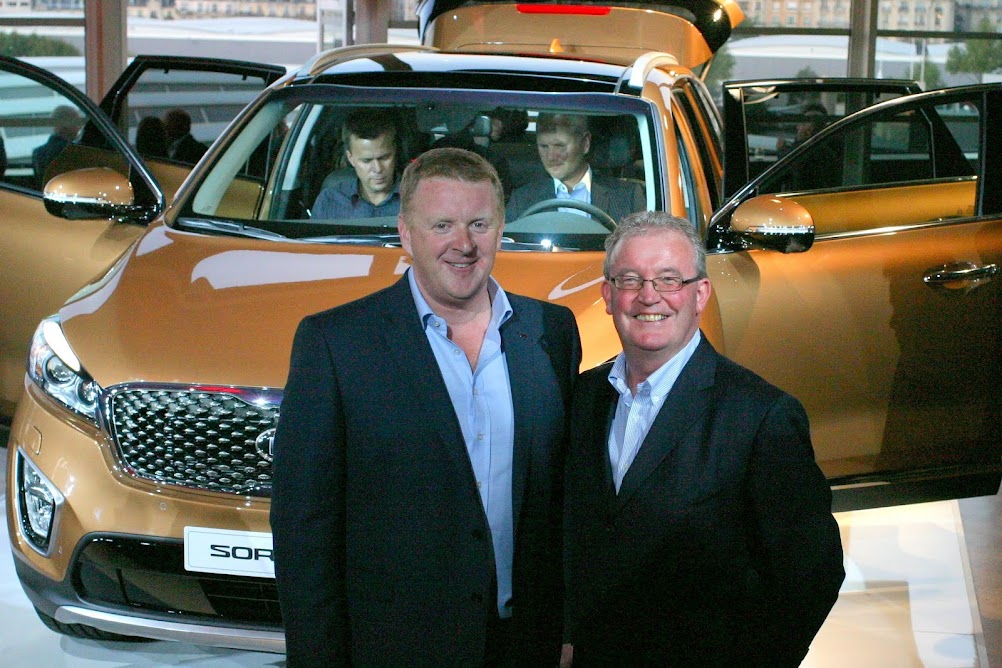
New Sorento gets 5-star safety rating

Kia's new generation Sorento has achieved a 5-star safety rating in the Euro NCAP crash test regime, writes Brian Byrne.

The car has a significantly stronger body shell and a wide range of active safety technology. Kia's new SUV scored highly in all four areas (90 percent Adult Occupant Protection, 83 percent Child Occupant Protection, 67 percent Pedestrian Protection and 71 percent Safety Assist)

It goes on sale across Europe in the first half of 2015. Pictured above at the Paris Motor Show debut of the new Sorento are James Brooks and Aidan Doyle of Kia Ireland.

10 September 2014

New car technology that could save your life

Cars that stop themselves could save as many lives as seatbelts did since they were introduced 30 years ago.

The Thatcham motor insurance research centre in the UK investigated the potential impact of autonomous emergency braking (AEB) and found that thousands of accidents could be prevented, or the effect lessened, if all cars were fitted with the technology from next year.

AEB uses a combination of laser and radar to detect an imminent collision with an obstacle in front of the car, and the automatically applies the brakes. If the driver fails to respond, the system brings the car to a complete halt.

Many car manufacturers currently fit these AEB systems as optional or standard on selected models in their range.

23 October 2013

5 Stars for Cherokee, CLA-Class, 2008 and SX-4

Jeep Cherokee, Mercedes-Benz CLA-Class, Peugeot 2008 and the Suzuki SX-4 have all been awarded a maximum five stars for safety in the latest round of Euro NCAP tests.

The Jeep Cherokee SUV tested was the 2.0 diesel 'Longitude', LHD version. It was awarded 92 percent for adult occupant protection, 79 percent for child occupant and 67 percent for pedestrian safety, and 74 percent for safety assist with Electronic stability control standard.

The Mercedes-Benz CLA-Class 200 in Urban spec received a 91 percent for adult occupant protection, 75 percent for child occupant, 74 percent for pedestrian safety, and 81 percent for its safety assist features Electronic Stability Control as standard. It also received Advanced Rewards for its Attention Assist and Collision Prevention Assist.

Peugeot's 2008 tested was the 1.2 Active, LHD version. It was awarded a 88 percent for adult occupant safety, 77 percent for child occupant, 72 percent for pedestrian, and 70 percent for safety assist. It also has electronic stability control as standard.

Suzuki's SX4 small family hatchback, 1.6 GL+ was awarded a 92 percent adult occupant protection score, 80 percent for child occupant, 72 percent for pedestrian safety and 81 percent for safety assist. It also has electronic stability control as standard.

8 March 2013

Latest Euro NCAP safety test scores

Skoda's new Octavia, as well as the new Toyota Auris and RAV4 vehicles have all scored a maximum five stars for safety under the new, tougher Euro NCAP programme for 2013.

Skoda's new third generation Octavia scored very high marks for front adult protection as well as for child safety and pedestrian protection.  It goes on sale here next week priced from €18,995-€27,995. Engines are a 1.2 86bhp TSI, 1.6 105bhp, and 2.0 150bhp TDI.

Toyota's new Auris is the first compact/family hatchback in the C-segment to receive a 2013 five-star rating. It is equipped with ABS with EBD and Brake Assist, Vehicle Stability Control and an emergency braking signal function. It also has a full complement of dual front, knee, side and curtain airbags. The car tested was the Auris 1.6 Valvematic.

The new fourth generation RAV 4 is the first SUV to gain the top 2013 rating. It offers more occupant protection and higher levels of active and passive safety than its predecessors. A new seat design helps reduce the risk of whiplash injury. It also boasts seven airbags as standard. The car tested was a 2.2 D-4D diesel all-wheel drive model.

24 January 2013

Euro NCAP's 2012 top choices for safety

In 2012, Euro NCAP published the results for 36 vehicles available on the European market.

Six five-star cars performed highly in each of the four individual marking criteria: adult occupant protection, child occupant protection, pedestrian protection, and safety assist systems.

The best in class of 2012 recommended by Euro NCAP for their outstanding safety performance are: Renault Clio supermini, Volvo V40 small family car, Ford B-MAX small MPV, Fiat 500L small MPV, Ford Kuga small off-road 4x4, Hyundai Santa Fe large off-road 4x4, BMW 3 Series large family car, and the Ford Transit, business/family van.

The Fiat 500L and Ford B-MAX share the Best in Class honour in the Small MPV category. The Volvo V40 reached the highest combined score of any car previously tested by Euro NCAP. While 26 5-star cars were released, one model achieved four stars and eight received three stars.

The test body said last year's under-performers were the Jeep Compass and Renault Trafic, each of which was only able to score two stars against the latest set of requirements.

The Ford Transit is the first van to achieve a Euro NCAP five star overall rating and to receive the best in class honour. Runners-up in this new category are the FIAT Scudo and its twins, the Citroen Jumpy and Peugeot Expert, all of which received three stars.

The next results from Euro NCAP will be released on 5 March 2013.

20 December 2012

Aygo and its twins get 3 stars in safety tests

Toyota and PSA Peugeot-Citroen have committed to improve safety features on their 'triplet' cars, after the facelifted models achieved 3-stars in Euro NCAP's latest test series.

All three cars - Toyota Aygo, Citroen C1 and Peugeot 107, have been recently facelifted from the previous models tested by Euro NCAP that achieved four stars for adult occupant protection back in 2005.

While the facelifted models are sold as new to the public, Euro NCAP say 'it is clear that they have failed to keep abreast of latest safety developments and standards'.

Euro NCAP test protocols have evolved significantly over the past few years with more stringent tests and requirements. "Despite this, many manufacturers have engineered their latest cars to achieve the highest 5-star score," says Dr Michiel van Ratingen, Euro NCAP Secretary General. "On the other hand, we see that some manufacturers continue to offer popular best sellers without making the necessary incremental updates to safety. It is those models that obviously fall behind other, more modern cars competing in the same category."

Euro NCAP say the current model of Aygo and its twins lack basic items such as side impact airbags and electronic stability control as standard equipment.

In response to the latest tests, Toyota has made a commitment to make some items as standard by July 2013. These include side thorax airbag, side head curtain airbag, electronic stability control, passenger seatbelt reminder, and ISOFIX and top-tether in rear outboard seats.

PSA Peugeot-Citroen has also committed to do the same with its 107 and C1 models.

31 October 2012

'Smart' paint lights up at night


A Dutch tech company has developed paint for roadways that 'charges' during the day and lights up at night, writes Brian Byrne.

Studio Roosegaarde and Heijmans Infrastructure have developed the paint, actually a luminous powder coating for road markings.

Another development is a 'smart' paint, which will make snowflake designs on the road visible below certain temperatures, to remind drivers to take care.

A test section of highway is due to be in use somewhere in Holland by the middle of next year.

15 October 2012

Nissan system stops wrong pedal crashes

Nissan has developed a system that will help stop accidents when drivers hit the accelerator instead of the brake, writes Brian Byrne.

In countries where automatic transmissions are common, there are regular accidents when cars run into walls ahead of their parking space instead of stopping because of mispedaling.

The system, Emergency Assist for Pedal Misapplication, uses cameras to see what's in front of the car, and if it senses that the car is accelerating instead of braking, it will take over both controls and stop the car.

EAPM will first be rolled out in a Nissan people-carrier in Japan.

30 August 2012

Volvo V40 is 'Europe's safest' car

The new Volvo V40 has achieved a 5-star rating and also the highest ever score recorded by the crash test regime of EuroNCAP, writes Brian Byrne.

In the individual measurements in the tests, the protection for adults was also the highest ever recorded, at 98 percent.

The provision of systems such as the WHIPS whiplash protection system are part of the reason for the high overall result, while in the safety assist category, the Volvo V40 scores maximum possible points.

Other systems include Pedestrian Detection and a special airbag to minimise injury to pedestrians hitting the windscreen, a Lane Keeping Aid which helps the driver stay within his or her lane, and BLIS which helps the driver detect vehicles in the offset rear ‘blind spot'.

Other cars which received the maximum 5-star rating in the latest ENCAP round of tests include the Renault Clio, the Ford B-MAX, and the Kia cee'd.

17 August 2012

Singing in the car not good

Do you sing in the car? If you do, your reaction times are slower than if you drive along in silence, according to Australian researchers.

They also found that singing drivers drive at more varied rates, though overall more slowly. They also showed less movement within lanes than those driving without musical accompaniment either from themselves or the radio.

The researchers are Genevieve M Hughesa, Christina M Rudin-Brown, and Kristie L Young from the Department of Psychology, Monash University.

22 June 2012

Seatbelt airbags for next Mondeo


In a first for a European car, Ford Has announced that seatbelt airbags will be available as an option in the rear of the next generation Mondeo, writes Brian Byrne.

The airbags are fitted inside the seatbelts, and in an impact are inflated by a blast of special cold gas through the buckle.

The bags spread the restraining forces across a wider chest area, helping to minimise the chances of rib fractures.

It is also suitable for children using booster seats. Ford engineers also note that the system is particularly useful in protecting elderly people, whose rib cages are naturally less strong than when they were younger.

The system is already in use in the Ford Explorer in the US, where it was introduced as an option in 2010. The company says that 40 percent of buyers of the Explorer opted for the safety feature.

No price has yet been given for the option on the Mondeo, due to go on sale in 2013.